
Рішення для фокусу та ясності мислення
Getting the modafinil dosage right is the single biggest factor separating a productive day from a sleepless night, a headache, and disappointment with the drug. Modafinil (brand name Provigil) is an FDA-approved wakefulness agent for excessive daytime sleepiness in narcolepsy, obstructive sleep apnea, and shift work sleep disorder [5]. In nootropic practice, however, users explore a wider range — from 50 to 400 mg per day. This guide covers everything you need to know about modafinil dosage: standard doses by indication, a complete modafinil dosage table from 50 to 400 mg, titration rules, dosing schedules, and safety limits.
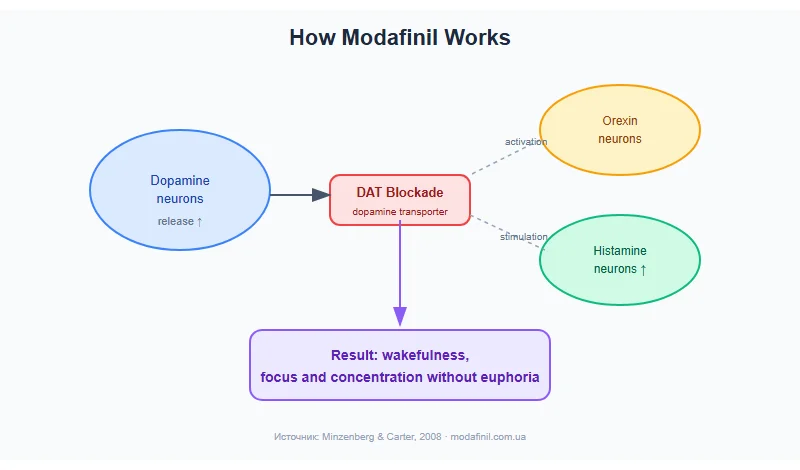
Modafinil raises levels of several neurotransmitters — dopamine, norepinephrine, serotonin, histamine, and glutamate [1]. The key mechanism is dopamine reuptake inhibition, which produces the wakefulness, motivation, and mental clarity effects [10]. Unlike classical stimulants, modafinil does not trigger a massive dopamine release, so it carries a low risk of dependence and a milder side-effect profile [4].
Modafinil has a half-life of 12–15 hours, with peak plasma concentration reached 2–4 hours after intake [9]. That is why the drug should be taken in the first half of the day — otherwise it will interfere with falling asleep. Pharmacokinetics, not “feelings,” is what makes the modafinil dosing schedule at least as important as the dose itself.
Before experimenting with doses, read our complete modafinil guide 2026, and for a quick personalized estimate use the modafinil dosage calculator.
Officially, modafinil is prescribed at 200 mg per day for all three approved indications [5]:
| Indication | Dose | Timing |
|---|---|---|
| Narcolepsy | 200 mg/day | Morning, ideally at the same time each day |
| Obstructive sleep apnea | 200 mg/day | Morning |
| Shift work sleep disorder | 200 mg/day | 1 hour before the shift starts |
According to the FDA label, “doses up to 400 mg/day, given as a single dose, have been well tolerated, but there is no consistent evidence that this dose confers additional benefit beyond that of the 200 mg dose” [5]. This is why 200 mg is considered the “gold standard” in both clinical practice and among nootropic users.
Tablets come in 100 mg and 200 mg strengths [12], which is convenient: most users split a 200 mg tablet in half or into quarters to get 100, 50, or even 25 mg. Pharmacies in Ukraine and online stores most often sell the 200 mg forms — they are the easiest to adapt to any protocol.
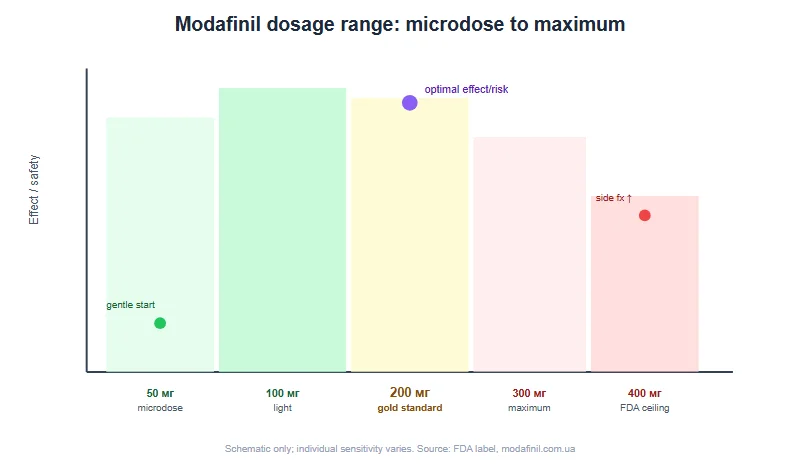
The most practical reference point is a modafinil dosage table built on clinical data and years of user experience [7][11]:
| Dose | Effect | Who It Suits |
|---|---|---|
| 50 mg | Mild focus boost for 2–3 hours, virtually no side effects | Stimulant-sensitive users, beginners, people over 65 |
| 100 mg | Noticeable focus improvement for 7–8 hours | Optimal starting point for most beginners |
| 200 mg | Full effect for 10–12+ hours | Standard dose for most users |
| 300 mg | Extra 1–2 hours of focus, sleep disruption risk | Extended wakefulness, extreme deadlines |
| 400 mg | Maximum clinical dose, more side effects | Clinical need only |
The Neuroscience Education Institute (NEI) formulated an important principle: for sleepiness, higher doses (200–800 mg) may work better, while for concentration problems and fatigue, lower doses (50–200 mg) can be paradoxically more effective [6]. In other words, a modafinil dosage table is not a rigid instruction — it is a range for individual fine-tuning.
The modafinil 200 mg dose is the best-researched dose in the scientific literature. It is the one recommended in the official SmPC: “The recommended starting daily dose is 200 mg. The total daily dose may be taken as a single dose in the morning or as two doses, one in the morning and one at noon, according to physician assessment of the patient and the patient’s response” [12].
In a study by Turner and colleagues, 200 mg consistently improved cognitive performance during overnight work, outperforming 100 mg and caffeine [11]. Most users feel all the desired effects — focus, motivation, mental clarity — with minimal side effects. Practitioners recommend taking 200 mg 1–3 days per week with at least 48-hour gaps between doses [7].
There is no solid evidence that splitting the daily dose into two 100 mg doses makes a real difference — most users prefer a single morning dose. The key rule: if 200 mg feels like too much, lower the dose rather than pushing through.
A classic modafinil dosing schedule looks like this: one dose in the morning, no later than 9:00, on an empty stomach or after a light breakfast [7]. Fatty food slows absorption and delays the peak by 1–2 hours [5], so taking the drug before a meal gives a more predictable effect.
Typical schedule options:
– Standard: 200 mg once in the morning, 2–3 times per week.
– Mild: 100 mg in the morning, 2–3 times per week — for those who find 200 mg too much.
– Split: 100 mg at 7:00–8:00 + 50–100 mg at 12:00–13:00 — for a long working day.
– Cyclic: “3 days on, 3 days off” — popular among experienced users to manage tolerance.
For shift work, the modafinil dosing schedule differs: the dose is taken 1 hour before the shift starts, regardless of the time of day [5]. If you notice the effect fading over time, take a 2–4 week break instead of raising the dose — see our article on modafinil tolerance for details.
Your personal modafinil dose is found by gradual titration, a method tested by thousands of users [7]:
It is important to understand that modafinil’s effect does not accumulate like that of classical stimulants. In the Repantis study, a single dose improved cognition under moderate sleep deprivation, but with repeated dosing the drug mostly maintained wakefulness rather than boosting performance [13]. So look for the minimum effective dose, not the maximum.
The maximum modafinil dose physicians may prescribe is 400 mg per day [14]. Research shows, however, that 300–400 mg offers no advantage over 200 mg for cognitive enhancement: in the Turner study, the benefit of 300 mg was attenuated the next day because of greater sleep disturbance [11]. In a study of French military personnel deprived of sleep for 64 hours, 300 mg was the only dose that maintained cognitive performance at baseline levels [8] — but that is an extreme scenario, not a working protocol.
Users who tested 400 mg reported brain fog, chronic fatigue, and difficulty concentrating [13]. Overdose symptoms include chest pain, elevated blood pressure, irregular heartbeat, hallucinations, and severe agitation [2].
For context: in clinical trials, doses of 1000–1600 mg/day for 7–21 days produced no life-threatening effects, and the largest recorded intentional overdoses were 4500 mg and 4000 mg — also without lasting harm [2]. The oral LD50 in rodents is 1.0–1.25 g/kg, meaning a lethal dose for a 70 kg human would be around 75 grams [16]. Even the largest single-day intake ever recorded (12 g) is 60 times the recommended maximum. Still, the maximum modafinil dose for nootropic purposes is 200 mg per day; 400 mg is reserved for clinical situations. Read more in our modafinil overdose article.
Microdosing means taking 1/5 to 1/10 of the standard dose — 50 mg or less [7]. For many people who find 100 mg “too much,” microdoses deliver all the benefits without any side effects. Microdosing can be especially useful for stimulant-sensitive individuals, people with liver issues, and those over 65 [15].
A popular protocol is “3 days on 25–50 mg, 3 days off,” gradually increasing the dose until you find yours [7]. For a full breakdown of this strategy, see our modafinil microdosing article.
The most common modafinil side effects are headache, nausea, anxiety, insomnia, dizziness, and dry mouth/eyes [3]. Their frequency scales directly with dose: at 50 mg they are virtually absent, at 100 mg rare and mild, at 300–400 mg noticeably more frequent [7][13].
Compared with traditional stimulants, modafinil is less likely to cause excessive locomotor activity, anxiety, jitteriness, or rebound effects [4]. Modafinil has a low risk of dependence but is not completely risk-free: regular use at high doses can lead to tolerance [14]. If you develop a skin rash, severe headache, or heart rhythm problems, stop taking it and see a doctor. The full overview is in our modafinil side effects article.
– People over 65: start with 50–100 mg, because elimination of the drug slows with age [15].
– Impaired liver function: reduce the dose by half — to 100 mg per day [5].
– Women taking hormonal contraceptives: modafinil can reduce their effectiveness, so the contraceptive regimen may need adjustment [17].
– Stimulant-sensitive individuals: start at 50 mg and titrate slowly.
– Pregnant and breastfeeding women: use is not recommended — see our articles on modafinil and breastfeeding and modafinil and birth control.
In Ukraine, modafinil can be ordered online with Nova Poshta delivery nationwide (1–2 days) and international shipping worldwide. The most popular format is 200 mg tablets, which split easily into any dose:
– Modvigil 200 mg (10 tablets) — from 270 ₴ — modafinil category
– Modalert 200 mg (10 tablets) — from 420 ₴ — product page
– Modawake 200 mg (10 tablets) — from 380 ₴ — product page
– Modafil MD 200 mg (10 tablets) — from 450 ₴ — product page
You can also order via Telegram — a consultant will help you pick the right brand and dosage for your goals.
Finding your modafinil dosage is an individual search within a well-researched 50–400 mg range. Start with 100 mg in the morning, titrate in 25 mg steps with 48-hour breaks, and listen to your body. For most users, the sweet spot is a modafinil 200 mg dose taken 1–3 times per week; for sensitive individuals, 50–100 mg works best. The minimum effective dose always beats the maximum: it delivers the same benefits with fewer risks to your sleep and health.
A: The standard dose is 200 mg per day for all approved indications: narcolepsy, obstructive sleep apnea, and shift work sleep disorder. It is the best-researched dose and the one recommended in the official FDA label and manufacturer SmPC [5][12].
A: Most practitioners recommend starting with 100 mg in the morning, no later than 9:00. If the effect is insufficient, try 125–200 mg after 2–3 days; if you feel overstimulated, drop to 50 mg [6][18].
A: Yes, 200 mg tablets can be split in half (100 mg) or into quarters (50 mg). This is standard nootropic practice, and most tablet forms have a score line for even splitting [3][26].
A: Practitioners recommend 2–3 dosing days per week with at least 48-hour gaps between doses. At 50 mg, 4–6 days per week is feasible. Daily use raises the risk of tolerance [4][25].
A: The official maximum is 400 mg per day, but studies show no added benefit above 200 mg. For nootropic purposes 50–200 mg is enough; 400 mg should be reserved for clinical need. Meta-analyses of healthy volunteers show no clear added cognitive benefit at higher doses [22][24].
A: Not recommended: with a 12–15 hour half-life, an afternoon dose will disrupt nighttime sleep. The exception is shift work, when the dose is taken 1 hour before the shift starts [11][19][27].
A: Yes — 50 mg produces a mild focus boost lasting 2–3 hours with virtually no side effects. For stimulant-sensitive people and older adults it is an ideal starting dose [21][23].
A: Prices start at 270 ₴ for 10 tablets of 200 mg (Modvigil); Modalert, Modawake, and Modafil MD range from 380 to 450 ₴. Nova Poshta delivery across Ukraine takes 1–2 days; international shipping is available.
This article is for informational purposes only and does not constitute medical advice. Modafinil is a prescription drug; consult your physician before starting it. Dosage information is based on published research and user experience and does not replace individualized professional recommendations.
