
Рішення для фокусу та ясності мислення
# Armodafinil Dosage Guide: How Much to Take (75–300 mg & Microdosing)
Finding the right armodafinil dosage is the single most important decision a nootropics beginner has to make. Unlike modafinil — which has been studied in medical research for decades and used by hundreds of thousands of smart-drug users worldwide — the evidence on armodafinil dosing is comparatively thin. Even a search for "armodafinil maximum dose" returns surprisingly little reliable data. This guide consolidates clinical trials, the manufacturer's prescribing information, and real user experience to answer the key questions: what is the standard dose, does an armodafinil maximum dose exist, how does armodafinil microdosing work, and how much armodafinil to take for steady focus across a full working day.
The safe starting point is to read the prescribing information and discuss the indication, timing, interactions, and monitoring plan with a clinician. This article explains what the evidence and official labeling do and do not establish; it is not a personal dosing protocol.
Armodafinil (brand name Nuvigil) is a wakefulness-promoting agent approved by the FDA in 2007 to treat excessive daytime sleepiness in three conditions: narcolepsy, obstructive sleep apnea, and shift work sleep disorder [1]. Chemically, it is the "R" enantiomer of modafinil — a compound that normally consists of two mirror-image molecules (R and S). Armodafinil contains only the more active R form, which is why many users describe it as the "purer" version of modafinil.
Off-label, healthy non-sleep-deprived individuals use armodafinil for a boost in mental performance: higher productivity, sharper focus, and the ability to work 10–12 hours straight. Research supports its cognitive effects, including improved memory, alertness, and attention [14], [17]. The critical difference from modafinil is pharmacokinetic: armodafinil has a half-life of 10–14 hours versus 3–4 hours for the S-enantiomer, so armodafinil dosage timing deserves extra attention [2].
Armodafinil was developed by Cephalon, the same company behind modafinil. The decision to isolate and market the R-enantiomer as a separate drug was driven by pharmacokinetics: because R-modafinil has a much longer half-life and is cleared far more slowly than the S-form, it dominates circulating levels during chronic use. In practical terms, one morning dose of armodafinil keeps you focused for a full workday — and the "smooth, even" profile is exactly what many users cite as the reason they prefer it over modafinil.
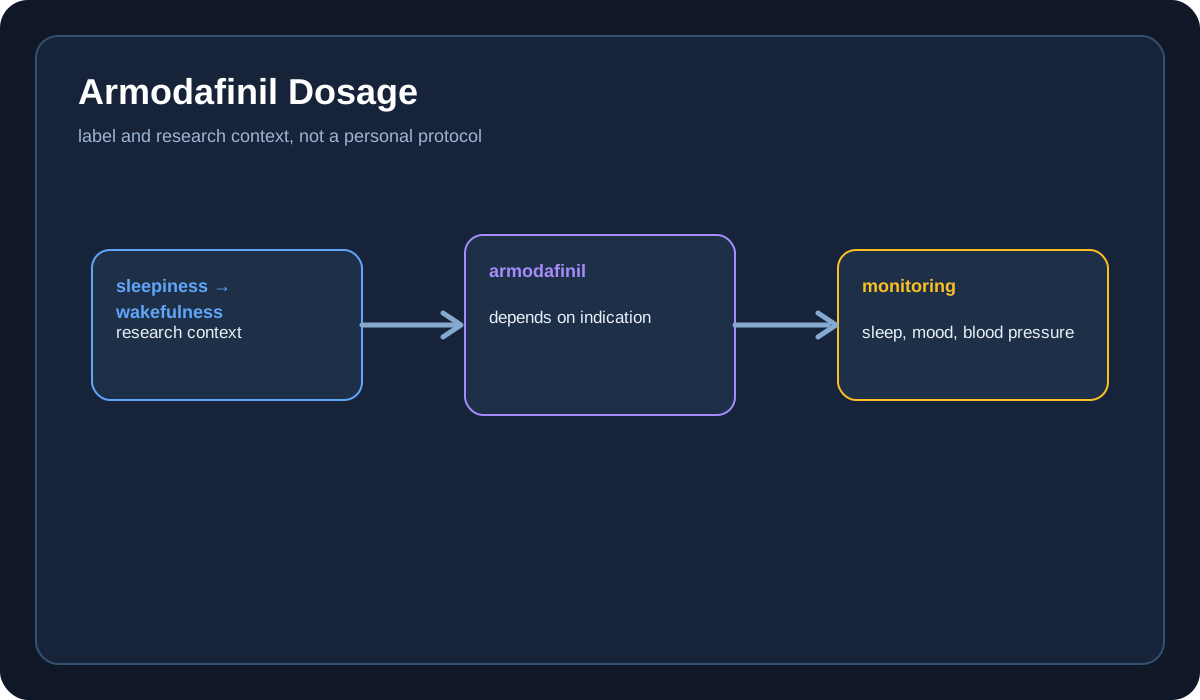
The mechanism of action is still being studied. Armodafinil blocks the dopamine transporter: in Volkow's PET study, modafinil (and therefore its R-isomer) occupied the dopamine transporter, raising synaptic dopamine levels [14]. This produces wakefulness without the classic stimulant profile of amphetamines.
Pharmacokinetics explain why armodafinil lasts longer than modafinil: the R-form has a half-life of 10–14 hours, while the S-form is cleared about three times faster. During chronic modafinil use, the R-enantiomer accumulates to levels up to three times higher than S-modafinil — so armodafinil essentially delivers the "active part" of modafinil in pure form [2]. Practical implication: a single dose holds focus longer, but the risk of insomnia rises if you take it late in the day.
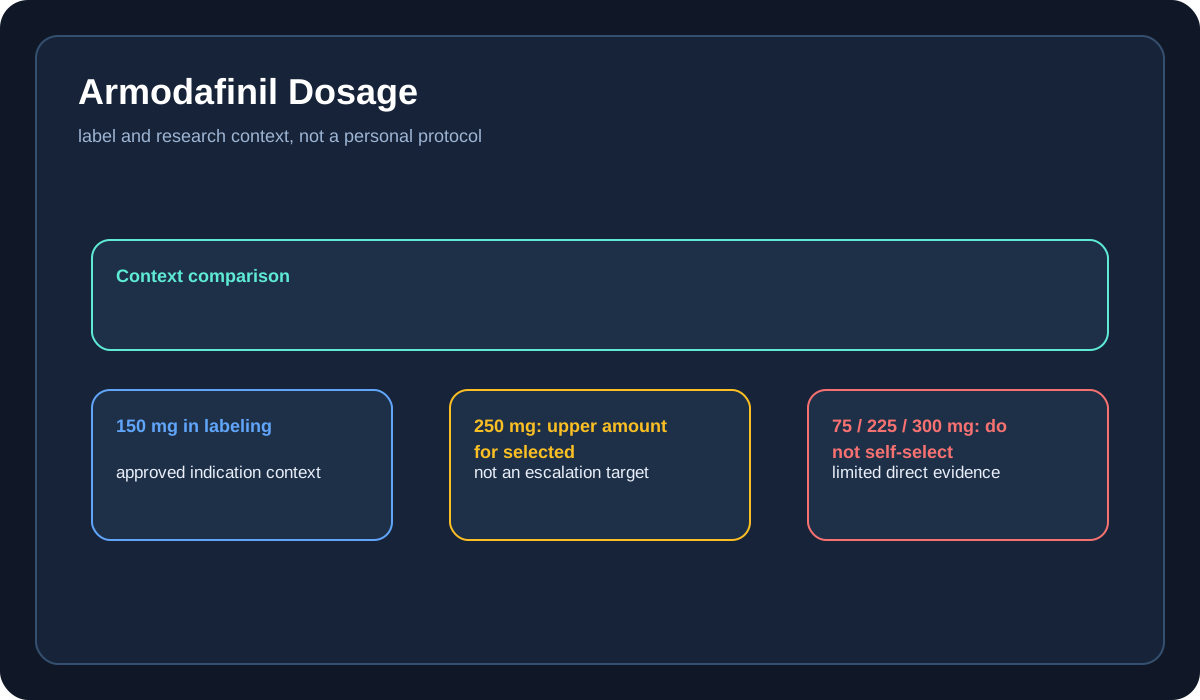
To help you orient quickly, here are the main dosing options in one table — a synthesis of clinical data [1], [4], [6], [8] and community experience [10].
| Label or study context | What the evidence says | Safety boundary |
|---|---|---|
| 150 mg for OSA or narcolepsy | Listed in U.S. prescribing information as a once-daily morning regimen | Follow the individual prescription; do not self-adjust |
| 150 mg for shift work disorder | Listed as a regimen taken before the work shift | Treat the underlying sleep disorder and follow clinical advice |
| 250 mg maximum in labeling | A labeled upper amount for selected indications, not proof of extra benefit | Not a self-directed target; higher exposure can increase risks |
| 75, 225, or 300 mg and microdoses | Discussed in online or research contexts with limited direct evidence | Not a personal protocol; do not select a dose from this table |
The key takeaway: for roughly 90% of users, 150 mg is the sweet spot. Higher doses rarely add proportional benefit but do add side effects [6].
The standard armodafinil dosage for nootropic purposes is 150 mg once daily, taken in the morning — ideally before 10:00 am. It provides 8–12 hours of uninterrupted concentration and matches clinical practice: for sleep apnea and narcolepsy, prescribers use 150–250 mg; for shift work disorder, 150 mg taken about one hour before the shift starts [7], [8].
A 2006 study in narcolepsy patients found that 150 mg was just as effective as 250 mg for improving wakefulness, memory, and fatigue scores — with no difference in side-effect frequency or severity [6]. More is not necessarily better: 150 mg is the evidence-backed starting point.
Another way to look at the standard dose: clinical studies referenced throughout the medical literature typically use 150–250 mg, but among healthy off-label users the overwhelming majority settle on 150 mg. It delivers the classic benefits — improved focus, better memory recall, sustained alertness — while keeping the side-effect burden minimal. For most people, this one morning tablet is the complete protocol.
"Armodafinil maximum dose" is one of the most common search queries. Clinical trials have used up to 250 mg, and a one-year open-label study covering 50–250 mg showed the drug to be effective and well tolerated [4], [5]. The licensed ceiling is 250 mg/day [1], [8].
A dose above the labeled regimen should not be used as a self-directed productivity experiment. The 225 mg and 300 mg figures that appear in online discussions are not a validated personal protocol; higher exposure may increase insomnia, anxiety, cardiovascular symptoms, or psychiatric reactions. Any adjustment belongs to a prescriber who knows the patient’s diagnosis, medicines, and risk factors. Tolerance and sleep-wake cycle disruption are real risks at high doses.
The 300 mg figure should not be treated as a productivity target. The available labeling does not establish that increasing exposure improves focus, while higher exposure can increase insomnia, anxiety, cardiovascular symptoms, and psychiatric reactions. A prescriber should decide whether a change is medically justified.
Armodafinil microdosing means taking less than 50% of the standard prescription dose. No clinical studies cover such tiny doses, so the protocol is built on individual titration. A well-known r/microdosing account is instructive [10]: 75 mg still caused side effects; 37.5 mg produced mild anxiety 1–2 hours after ingestion with unchanged social interaction; 18.75 mg (1/8 of a 150 mg tablet) delivered clean mental focus with no side effects — and coffee worked synergistically at that dose.
There is no validated clinical microdosing protocol for armodafinil. Online reports about splitting tablets or using very small amounts are anecdotal and do not establish effectiveness or safety. Do not alter, split, or taper a prescription product unless the prescriber or pharmacist confirms that the specific formulation can be handled that way.
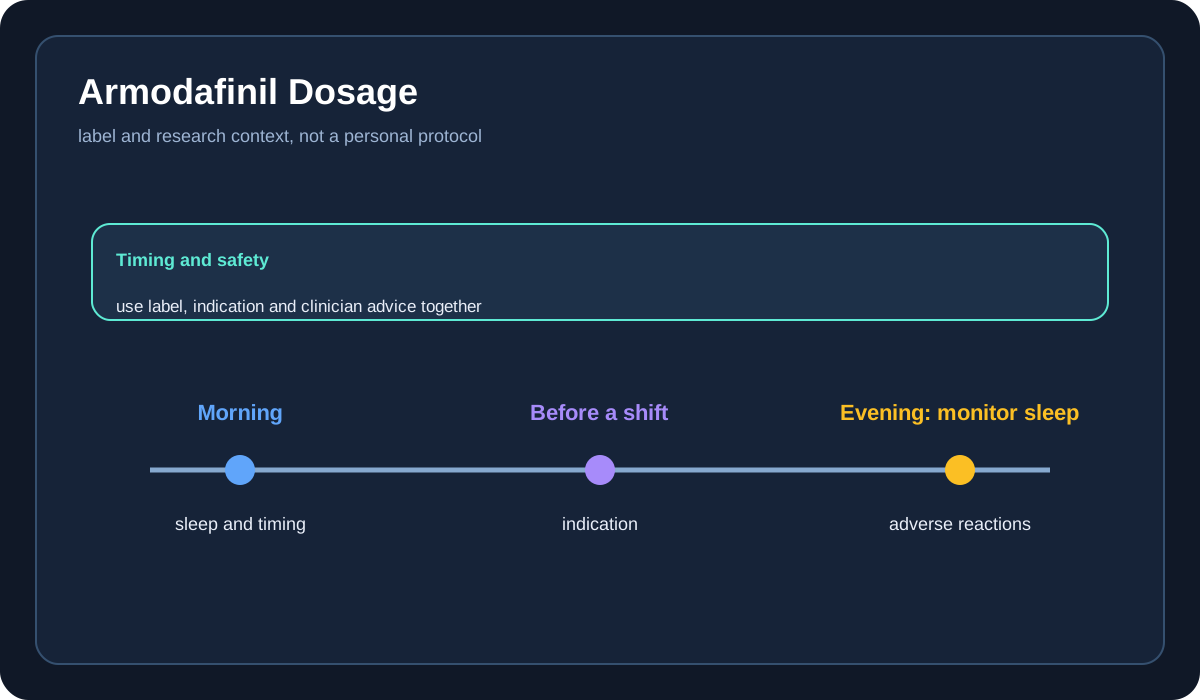
Timing matters almost as much as dose. With a 10–14 hour half-life, armodafinil taken after lunch will almost certainly disrupt your night's sleep [2]. The golden rule: take it right after waking, with or immediately after breakfast. Food slows absorption and smooths the effect peak; plenty of water cuts the risk of headache and dry mouth.
For night-shift workers the schedule is different: 150 mg taken approximately one hour before the shift starts — the exact regimen approved by the FDA for shift work disorder [8]. Night owls on flexible schedules can take it a little later in the morning, but not after 11:00–12:00, or they risk a sleepless night and a vicious cycle of chronic sleep deprivation. Remember: armodafinil is a tool for a productive day, not a substitute for sleep.
There is no universal answer to "how much armodafinil to take" — the right dose depends on body weight, sensitivity, and experience. Experienced modafinil users have a simple rule of thumb: 200 mg of modafinil ≈ 150 mg of armodafinil in terms of effect duration and strength [9]. In Tembe's randomized trial, armodafinil 150 mg was comparable in efficacy to modafinil 200 mg in patients with shift work sleep disorder [9].
People starting armodafinil should follow the prescribed product instructions and review the plan with a clinician rather than selecting a dose from an online table. Take armodafinil in the morning, with food, and drink plenty of water — this reduces the risk of nausea and headache. There is no universally safe weekly frequency for unsupervised long-term use. Ongoing treatment should be reviewed clinically, especially when sleep, mood, blood pressure, or interacting medicines are involved.
Comparing armodafinil 150 mg vs modafinil 200 mg is the most common question when choosing between the two drugs. The doses are roughly equivalent in strength, but the profiles differ: armodafinil works more smoothly and lasts longer (10–14 h vs 12–15 h), while modafinil has a more pronounced early peak. A shift-work trial compared study regimens, but those results do not make the products or doses interchangeable for an individual [9].
| Parameter | Armodafinil 150 mg | Modafinil 200 mg |
|---|---|---|
| Half-life | 10–14 h | 12–15 h |
| Effect peak | smooth, long-lasting | pronounced, fast onset |
| Focus duration | 8–12 h | 10–14 h |
| Side effects | milder | more headaches, GI upset |
Modafinil wins for all-nighters and marathon sessions; armodafinil fits a standard workday followed by healthy sleep.
At an excessive armodafinil dosage, side effects become more noticeable: nausea, headache, dizziness, anxiety, dry mouth, and insomnia [3]. In the one-year study (50–250 mg), armodafinil was effective and well tolerated, with minimal mild side effects [4]. Importantly, There is no reliable human lethal-dose threshold that can be used to judge an overdose, and findings from modafinil studies cannot be used to declare armodafinil safe at high amounts [12], [13]. Suspected overdose, chest pain, severe agitation, confusion, seizure, trouble breathing, or a serious rash requires urgent emergency help. See our detailed guide on armodafinil side effects.
Real-world experience deserves its own section because it shapes the practical advice. Most users converge on 150 mg as the ideal "working" dose: "I take it at 8 am, full clarity until noon, a steady background through the afternoon, and I fall asleep easily by 10 pm." Sensitive users report that 75 mg delivers enough focus for 6–7 hours of work, while 300 mg is almost always excessive: "I tried 300 mg — couldn't sleep for two days, the effect was too aggressive."
Taking an additional dose because the effect seems to be fading can increase total exposure and disturb sleep. Do not repeat or split doses on your own; ask the prescriber or pharmacist what to do if the effect, timing, or sleep response is unsatisfactory.
Armodafinil combines well with a number of agents, and a smart stack can improve the effect without raising the dose. The classic is caffeine: at microdoses of 18.75–37.5 mg, coffee works synergistically, delivering clean focus without anxiety [10]. At the standard 150 mg dose, better to cap caffeine at one morning cup — the combined stimulation can trigger palpitations and jitteriness.
There is not enough evidence to treat L-theanine, choline, or other supplements as a proven way to make armodafinil safer. Combining prescription wakefulness medicines with stimulants or supplements should be discussed with a clinician or pharmacist Other stimulants — amphetamines, cocaine, or high-dose caffeine — should be avoided categorically: the cardiovascular risk multiplies. Start any combination at minimal doses and only after consulting a physician.
In Ukraine, armodafinil is available as 150 mg generics — the exact standard dose from this guide. The armodafinil category at modafinil.com.ua currently includes:
The modafinil category can be used to compare alternatives; use the armodafinil category above for armodafinil products. Approximate conversions at 45 UAH/USD: $8.0 for Artvigil 10, $9.7 for Waklert 10, $46.7 for Waklert 50, and $77.6 for Artvigil 100.
Delivery across Ukraine is via Nova Poshta, usually 1–2 days; international shipping worldwide is also available. Orders can be placed via Telegram. Before buying, we recommend reading our complete modafinil guide.
The appropriate armodafinil dosage depends on the approved indication, the product information, comorbidities, interactions, and individual response. The labeled regimen is a reference for clinical discussion, not permission to self-medicate or escalate.
Before ordering, check that the armodafinil dosage matches a clinician-directed plan rather than advice from a forum.
The product card lists pack size separately, but armodafinil dosage is not determined by the number of tablets in a package.
When comparing delivery options, armodafinil dosage remains a medical question, not a condition of price or dispatch speed.
For a repeat order, keep the product name and indication recorded: armodafinil dosage should not change simply because the brand changes.
During a pharmacist consultation, list every medicine because armodafinil dosage may require an additional interaction review.
This commercial section helps locate the product, but armodafinil dosage should be agreed with a qualified healthcare professional.
The final armodafinil dosage is determined by the clinical question and tolerability, not by a product advertisement.
If a new symptom appears, armodafinil dosage should be reviewed with a clinician before any change in the regimen.
Two available pack sizes do not mean that armodafinil dosage should automatically double when a larger package is ordered.
Official labeling lists 150 mg once daily for selected approved indications, but the actual prescription depends on the patient and clinician’s decision [1].
Daily use is appropriate only within a clinician-directed plan and clinical monitoring. Do not change frequency on your own if the effect seems weaker.
Studies compared particular regimens, but these doses should not be treated as interchangeable for an individual [9].
Suspected overdose, chest pain, severe agitation, confusion, seizure, trouble breathing, or a serious rash requires immediate emergency help.
There is no validated clinical microdosing protocol. Do not split, crush, or alter a prescription product without a clinician or pharmacist.
Timing depends on the indication and the prescribed product information. Confirm it with a clinician, especially with shift work or sleep problems.
An upper amount in labeling applies to selected medical indications and is not a target for self-directed escalation. Higher exposure may increase adverse-reaction risk [16].
Interactions and combined stimulation should be discussed with a clinician or pharmacist; palpitations, anxiety, or insomnia warrant medical review.
