
Рішення для фокусу та ясності мислення
The modafinil half-life helps explain why evening exposure can disrupt sleep. The question of modafinil morning or night depends on the diagnosis, sleep schedule, other medicines, and individual response; the modafinil duration of action is not a personal dosing instruction.
The modafinil half-life is an important pharmacokinetic measure when reading about work, study, or shift schedules. It describes how quickly concentration declines, but it does not by itself determine subjective onset, the length of focus, or when a person will fall asleep.
In this guide, we explain what the modafinil half-life means according to clinical trials, how reports of duration relate to pharmacokinetics, why timing depends on individual factors, and how dose data should be interpreted without turning it into a personal regimen. The article is based on the FDA prescribing information, PubMed publications, and systematic reviews. If you are new to the compound, start with the [complete modafinil guide](/en/modafinil-guide-2026/) — here we focus specifically on pharmacokinetics.
Modafinil is a wakefulness-promoting agent (a eugeroic) approved by the FDA for narcolepsy, shift work sleep disorder, and obstructive sleep apnea. Its core indication is excessive daytime sleepiness: modafinil helps patients stay alert and functional during normal working hours [1]. Beyond its approved uses, the drug has become famous as a “smart drug”: students, programmers, entrepreneurs, and physicians use it off-label for improved concentration, memory, and productivity around deadlines [2, 12]. Off-label popularity does not establish that it is safe or appropriate for healthy people [13].
Its mechanism of action is still being studied, but researchers have identified the key players: modafinil activates hypothalamic wake-promoting regions — most notably the tuberomammillary nucleus and orexin-producing neurons — and reduces GABA release in the cortex and posterior hypothalamus [2]. That is why the experience differs from classical stimulants such as amphetamines: the effect is smoother, without a sharp spike and an equally sharp crash. Still, like any CNS-active drug, modafinil demands an understanding of its pharmacokinetics — starting with its half-life.
Before we get to specific numbers, let us clarify the term. The biological (elimination) half-life is the time required for the plasma concentration of a drug to drop to exactly half its original value [3, 4]. For example, a mathematical model for an initial amount of 200 mg gives about 100 mg after one half-life, 50 mg after two, and 25 mg after three. After four half-lives, the model gives about 6.25% of the original amount, but this is only a calculation, not proof of complete elimination or a safety threshold [5].
Two things matter here. First, the half-life of a given drug is a relatively constant value — it does not depend on the dose. Second, the same drug can clear faster or slower in different people depending on age, liver function, genetic variants of metabolic enzymes, and other medications taken at the same time.
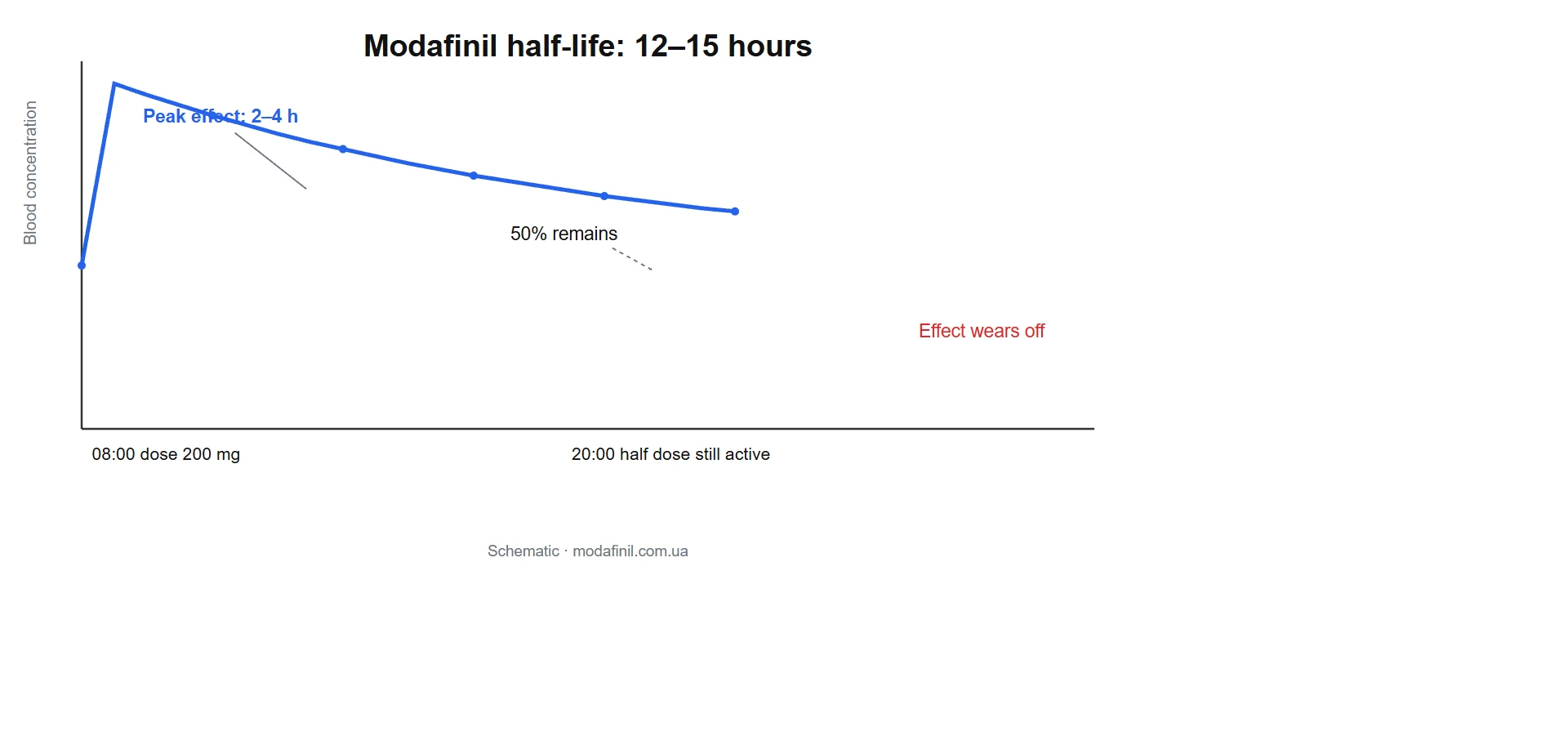
Now to the main question. Studies report slightly different figures because clearance depends on dosing schedule and individual traits:
| Source | Half-life | Notes |
|---|---|---|
| FDA PROVIGIL prescribing information | ~15 hours | effective half-life after multiple doses [6] |
| Thorpy, 2007 (Sleep Medicine) | 9–14 hours | review of narcolepsy therapy [7] |
| Systematic review, Kim, 2012 | 12–15 hours | analysis of practical use [8] |
| Wong et al., 1999 (J Clin Pharmacol) | ~15 hours | healthy male volunteers, 200–600 mg [9] |
The cited pharmacokinetic materials describe the modafinil half-life as a range rather than a personal timer: the FDA label gives about 15 hours [6], other reviews report roughly 9–14 or 12–15 hours [7, 8], and the Wong study reports about 15 hours [9]. The modafinil half-life in any particular article should therefore be read alongside the participants and protocol. After one half-life, the modeled amount falls by about half, but that does not become a personal schedule.
The half-life is not the same as the duration of the effect. Plasma concentration peaks 1–2 hours in the pharmacokinetic study described by Wong et al. [10]. Subjective focus and alertness can differ from the laboratory curve and between people; in sleep-deprivation protocols, modafinil was studied during prolonged alertness tasks [14]. These findings explain why the question “how long does modafinil last” has no single answer and should not become a ready-made intake schedule.
Key nuance: even after the subjective effect fades, the drug may remain in the body. Whether a substance is visible on a test depends on the sample, detection limit, and laboratory method; there is no universal period for every test [6, 15]. The answer to “how long does modafinil last” therefore needs a qualifier: blood concentration, perceived alertness, sleep, and a specific test are different outcomes.
Because modafinil’s influence can last a long time, later exposure can substantially delay sleep in some people. If insomnia, grogginess, or brain fog appears after exposure, discuss it with a physician rather than attributing it only to the half-life.
Make no mistake: modafinil is not a substitute for sleep. Sleep loss itself can impair attention, mood, and recovery, while stimulation can mask fatigue. Individual sleep risk depends on the situation and accompanying factors. The modafinil half-life does not provide a universal bedtime rule; timing and symptoms need clinical context.
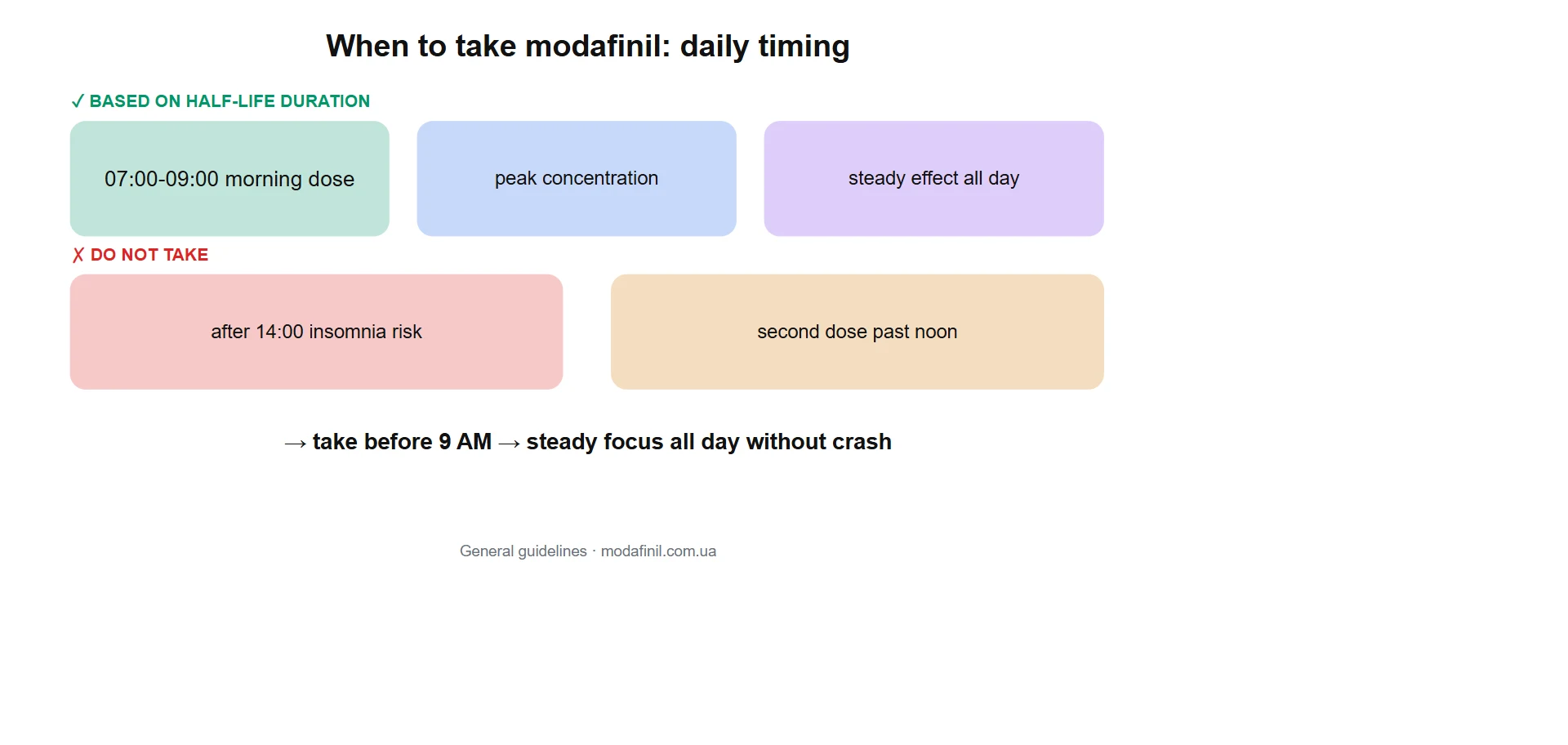
The question of when to take modafinil has no identical answer for everyone. Timing is related to the diagnosis, sleep schedule, shift work, other medicines, and individual response. Even when the question is framed as modafinil morning or night, the final decision should not be taken from an internet schedule.
During a clinical discussion, clinicians commonly consider:
| Timing factor | Why it matters |
|---|---|
| Usual sleep schedule | Later exposure may reduce sleepiness at the intended time and shift sleep onset. |
| Shift work | Timing is matched to the shift and medical indication, not to one universal clock time. |
| Individual sensitivity | The same concentration can produce different subjective duration in different people. |
| New or severe symptoms | They require stopping self-experiments and seeking medical assessment. |
In practice, the answer to how long does modafinil last should not become a personal schedule. For night shifts and other unusual schedules, discuss timing
with a physician; the [Modafinil category](/en/product-category/buy-modafinil/) contains current assortment information.
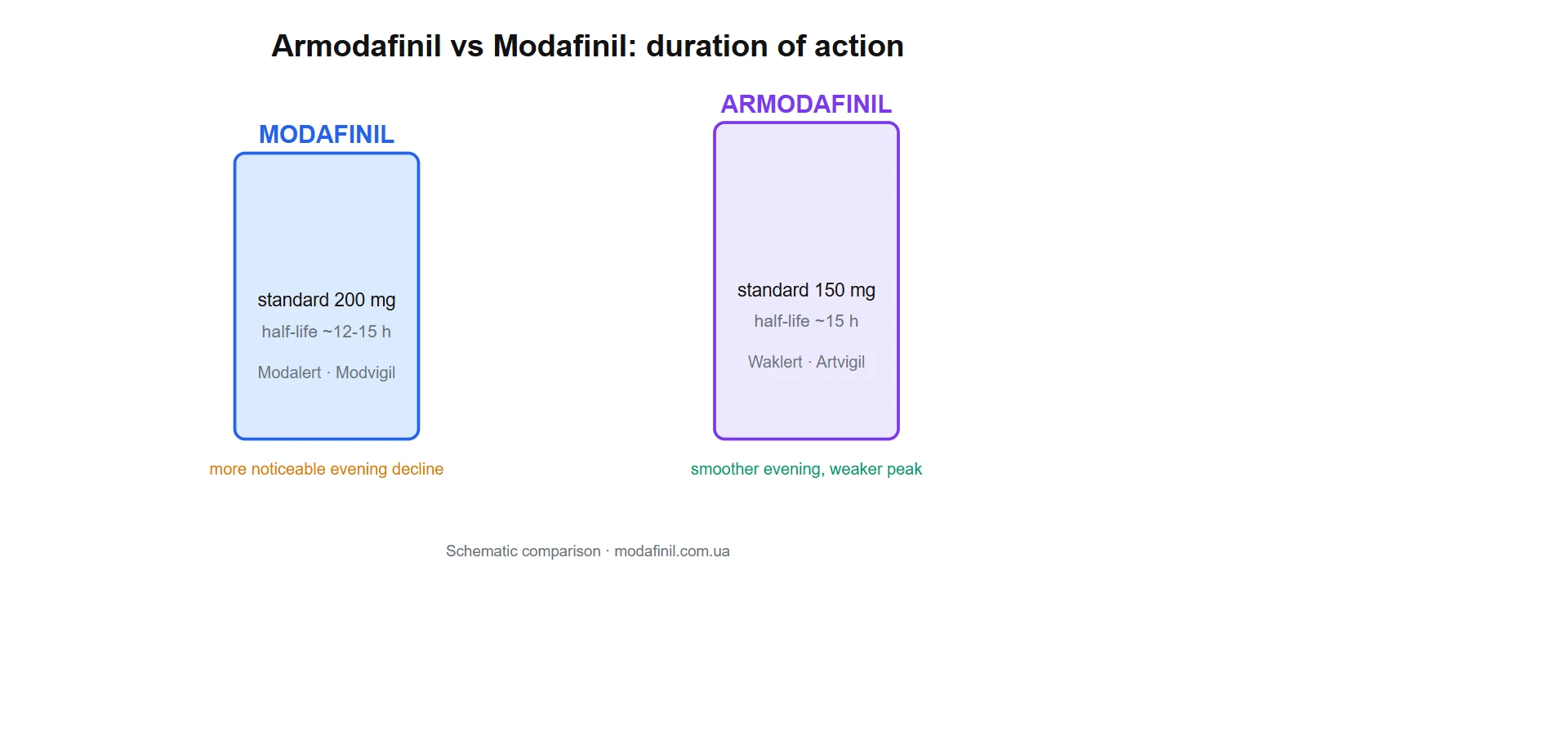
A common question is how armodafinil differs. Armodafinil is the “R”-enantiomer of modafinil — the more active form of the molecule. According to a pharmacokinetic study, the modafinil half-life is ~14.4 hours, while the armodafinil half-life is ~16.5 hours [18]. This makes sense: the “R” isomer clears in about 15 hours, whereas the “S” isomer clears in only about 4 hours [18].
Despite similar half-lives, the concentration profiles differ substantially: late in the day, plasma levels of armodafinil are higher than those of modafinil on a milligram-to-milligram basis [19]. This describes a pharmacokinetic difference, not a guarantee of the same subjective wakefulness for every person. If you want a deeper comparison, browse the [Armodafinil category](/en/product-category/buy-armodafinil/).
Modafinil dosage depends on the indication, age, coexisting conditions, liver function, and other medicines. Numbers from clinical studies describe a specific protocol and are not personal recommendations. Do not start, increase, or split a dose on your own: this matters especially when comparing modafinil duration of action across sources.
| Context | What the sources describe | Safe interpretation |
|---|---|---|
| Approved indication | Studied doses and timing in the label for a specific diagnosis | The clinician selects the regimen. |
| Pharmacokinetic study | Concentration, peak, and half-life | Group results do not set an individual schedule. |
| Shift work | The relationship between exposure timing and alertness | Sleep, medicines, and work safety need assessment. |
| Adverse reactions | Insomnia, headache, nausea, and other symptoms | New or severe symptoms require medical care. |
If you are asking how long does modafinil last or when to take modafinil, use these data as topics to discuss with a physician, not as a ready-made plan. Current product information is available in the [Modafinil category](/en/product-category/buy-modafinil/).
Catalog prices checked on August 27, 2026 vary by brand and pack size: Modvigil 200 mg, 10 tablets — UAH 270, 100 tablets — UAH 2,490; Modalert 200 mg, 10 tablets — UAH 420, 100 tablets — UAH 3,990; Modawake 200 mg, 10 tablets — UAH 380, 100 tablets — UAH 3,550. Prices and delivery can change, so check the product page and the Modafinil category before ordering.
The 12–15-hour half-life range helps describe pharmacokinetics, but it does not establish the same detection time for every test. Modafinil is metabolized mainly through CYP3A4 and can affect CYP2C19, CYP2C9, and CYP1A2 [6]. Concentrations of other medicines may therefore change; the direction and clinical significan
ce depend on the specific substance and require medical assessment.
As for drug tests: a standard drug screen may not be designed to look for modafinil, but that does not guarantee the same result across laboratories. Specialized panels, methods, and interpretation rules vary. If you are an athlete, check the current WADA list and your federation rules: modafinil may be prohibited in sport [20].
Modafinil should not be described as “completely safe.” Reported adverse reactions include headache, insomnia, nausea, dry mouth, and reduced appetite; their likelihood and intensity vary. Rare but serious risks include skin reactions, including the very rare Stevens–Johnson syndrome, and reduced effectiveness of hormonal contraceptives — this issue should be discussed separately with a physician [6].
Unlike amphetamines, modafinil at therapeutic doses rarely causes tremor, jitteriness, or an “adrenaline rush”; the risk of misuse is considered low [16]. Still, it is a prescription drug: consult your physician before starting, especially if you have cardiovascular disease, liver or kidney impairment, or take other medications.
Long-term or repeated use can change how the effect feels, but there is not enough evidence for one universal regular-break schedule. Do not copy forum schedules or change the dose without medical guidance. If the effect changes or insomnia, anxiety, or other symptoms appear, the cause needs assessment rather than an automatic dose increase. For a general pharmacokinetic comparison, see [modafinil vs armodafinil](/en/modafinil-vs-armodafinil-comparison/).
The modafinil half-life in a label or clinical study is an estimate for a population, not a personal timer. Age, liver function, genetic enzyme variants, other medicines, and the study protocol can all affect how the number should be interpreted [6]. One figure therefore cannot answer every version of the question, including how long does modafinil last for one particular person.
Differences between studies do not necessarily mean that one source is wrong. Researchers may use different formulations, sampling times, numbers of doses, participant groups, and calculation methods. The modafinil half-life is therefore better presented as a range than as a promise that the same result will occur for everyone.
Liver function matters because modafinil is metabolized mainly through hepatic enzymes. If a clinician knows about liver or kidney disease, that information can change the need for monitoring or adjustment. Data from healthy volunteers should not be transferred to a different clinical situation without medical interpretation [6].
Drug interactions also change the practical meaning of the number. Modafinil can affect CYP3A4, CYP2C19, CYP2C9, and CYP1A2 pathways, so a complete list of prescription medicines, over-the-counter products, and supplements is important in a clinical discussion [6]. Hormonal contraception deserves specific attention because its effectiveness and any additional precautions should be discussed with a physician.
Food changes the rate of absorption and the time to peak concentration rather than rewriting the concept of the modafinil half-life. A fatty meal can delay absorption, which may make the perceived onset later [10]. This is one reason a person may describe modafinil duration of action differently on different days even when the product is unchanged.
It is useful to separate laboratory pharmacokinetics from how someone feels. When people ask how long does modafinil last, they may mean the blood concentration, alertness, ability to fall asleep, or detectability of a metabolite. These are different outcomes and do not share one exact end time.
The modafinil half-life does not automatically predict work or study quality. Sleep, stress, caffeine, nutrition, an underlying condition, and expectations also affect attention. A stable research value does not mean that the medicine replaces rest or that the subjective effect will feel identical at every exposure.
For a clinician discussion, prepare the usual sleep and wake times, a list of medicines and supplements, previous reactions to stimulants, relevant test results, and the treatment goal. This context helps explain when to take modafinil in a specific situation without turning general information into a self-directed schedule.
Researching the modafinil half-life should not delay medical help when new or severe symptoms appear. Urgent assessment is appropriate for a rash, blisters, mucosal involvement, facial swelling, or trouble breathing because rare skin and allergic reactions can be serious [6].
Do not explain chest pain, fainting, marked palpitations, severe agitation, confusion, or major mood changes only as a sign that the medicine “lasts a long time.” In those situations, symptoms and safety matter more than trying to calculate how long does modafinil last without help.
If insomnia, anxiety, nausea, or headache appears, tell a clinician, particularly when symptoms recur or worsen. Do not automatically change the dose or add caffeine or another stimulant to “balance” modafinil duration of action. The modafinil half-life explains why the substance can remain present, but it does not identify the cause of an adverse reaction.
Also disclose pregnancy, plans for pregnancy, breastfeeding, hormonal contraception, liver or kidney disease, and psychiatric or cardiovascular conditions. These factors can change the benefit–risk assessment and the monitoring plan [6].
The modafinil half-life is often searched as one exact number, but medical sources should be read in context. Check whether the source describes a single exposure or repeated dosing, healthy volunteers or patients, plasma concentration or subjective alertness. Context explains why reliable sources can report similar but non-identical figures.
When asking how long does modafinil last, separate time to peak concentration, the period of noticeable alertness, and the gradual decline of the substance in the body. The modafinil half-life describes only the last pharmacokinetic process and cannot guarantee a particular duration of attention.
Blood measurements also do not measure sleep quality, work performance, or mood. Someone may no longer feel a marked effect while the substance remains present. Conversely, insomnia or anxiety can outlast the subjective stimulation. That distinction is central to interpreting modafinil duration of action.
When reviewing a study, check the sample size, exposure, sampling times, co-medications, and whether participants were healthy. The modafinil half-life reported in one study should not be presented as a promise for someone with different liver function, age, or treatment context [6].
Here are the key facts about the modafinil half-life and modafinil duration of action:
The answer to when to take modafinil depends on the indication and sleep schedule, not on a universal internet rule. Modafinil is a prescription medicine, so consult a physician before use. Current assortment information is available in the [Modafinil category](/en/product-category/buy-modafinil/).
If you have already sorted out the timing, the next question is where to buy a quality product. Our catalogue carries factory-made generics from verified manufacturers:
• Modvigil 200 mg, 10 tablets — UAH 270 (~$6.0)
• Modalert 200 mg, 10 tablets — UAH 420 (~$9.4)
• Artvigil 150 mg, 10 tablets — UAH 360 (~$8.0)
• Waklert 150 mg, 10 tablets — UAH 435 (~$9.7)
Bulk packs cost less per tablet. Nova Poshta delivery across Ukraine takes 1–2 days; international shipping runs 7–21 days.
More options in our modafinil catalogue and armodafinil catalogue.
1. Q: What does the modafinil half-life mean?
A: Clinical materials describe the modafinil half-life as a range of 12–15 hours: the FDA label gives about 15 hours [6], other reviews report roughly 9–14 or 12–15 hours [7, 8], and the Wong study reports about 15 hours [9].
2. Q: How long does modafinil last after taking it?
A: “How long does modafinil last” depends on what is being measured. The pharmacokinetic study describes peak concentration at 1–2 hours [10], but subjective alertness and sleep can differ; whether the substance appears on a test depends on the specific method [6, 15].
3. Q: When to take modafinil so it does not disrupt sleep?
A: There is no universal time: later exposure can delay sleep, while shift-work timing should follow the label and a clinician’s assessment. Do not use a fixed internet schedule as personal advice.
4. Q: Do modafinil and armodafinil differ in half-life?
A: The difference describes pharmacokinetics and does not guarantee the same subjective wakefulness. Studies report about 14.4 hours for modafinil and 16.5 hours for armodafinil; higher late-day armodafinil concentrations are also described [18, 19].
5. Q: How long does modafinil stay in your system and will it show up on a drug test?
A: Whether modafinil appears on a test depends on the sample, detection limit, method, and laboratory purpose. A standard panel may not be designed to look for it, while specialized methods have their own interpretation rules [6, 15].
6. Q: Can I split my dose and take modafinil twice a day?
A: Do not add or split a dose on your own. Additional exposure can create another concentration peak and delay sleep; a clinician determines whether any change is appropriate.
7. Q: Does food affect how fast modafinil kicks in?
A: Food can change the rate of absorption and the time to peak concentration; the reported result depends on the study conditions [10]. This does not justify changing a prescription without medical guidance.
This article is for informational and educational purposes only and does not constitute medical advice. It is not a substitute for professional medical consultation, diagnosis, or treatment. Always consult your physician before taking modafinil or any other nootropic. Modafinil is a prescription medication; self-medication can be harmful to your health. Price and delivery information is approximate and subject to change.
