
Рішення для фокусу та ясності мислення


In this modafinil vs armodafinil comparison we look at how modafinil and armodafinil differ: composition, pharmacokinetics, dosing, adverse reactions and price. Similar names do not mean an identical profile of action: modafinil and armodafinil are different molecules.
The key questions in any modafinil vs armodafinil comparison are how long the effect lasts, which one is ultimately better, how blood concentrations differ, and which risks should be discussed with a doctor. Deciding to buy a prescription drug does not replace medical advice.
This article helps you weigh the published data; it is a detailed armodafinil vs modafinil comparison across key parameters, so you can understand what fits a specific clinical situation. It is not intended for self-selecting therapy or using the drugs outside approved indications.
In short: in the armodafinil vs modafinil question, composition matters first: modafinil contains R- and S-enantiomers, while armodafinil contains only the R-enantiomer. In studies, armodafinil produced higher later plasma concentrations when compared milligram for milligram; the clinical significance for any individual depends on the indication and the doctor’s prescription.
🛒 Have you chosen your medicine?
Compare prices and availability — and decide whether to buy modafinil or buy armodafinil — in our catalogs. Both catalogs let you buy armodafinil generics and original brands with delivery across Ukraine. This modafinil vs armodafinil guide is a good starting point:
Where to buy modafinil: catalog
Where to buy armodafinil: catalog
If you plan to buy armodafinil, compare the 150 mg generics first — they differ mainly in manufacturer and price, not in the active substance.
Before any modafinil vs armodafinil comparison, it is important to separate approved medical indications from talk about “nootropics”. Modafinil is a prescription medicine, and its use requires an assessment of contraindications and drug interactions.
We have already published The Complete Modafinil Guide (2026): how it works, effects, safety and usage rules. Here we add even more detail…
Modafinil is a prescription drug approved by the FDA in 1998 under the brand name Provigil. Understanding modafinil vs armodafinil starts with understanding each molecule. In the US it is used for excessive daytime sleepiness associated with narcolepsy, obstructive sleep apnea and shift work sleep disorder [ 1 ]:
In these conditions the drug is prescribed under medical supervision; this is why questions like buy modafinil or buy armodafinil must always go through a doctor. it does not eliminate the cause of the sleep disorder and does not replace treatment of the underlying disease.
Publications discuss possible cognitive effects of modafinil in specific research settings [ 2 ]. These data are not a recommendation to use the drug in healthy people or for sleep deprivation without a prescription:
“…clinical studies have also documented a beneficial effect of [modafinil] on cognitive performance in people who were experimentally sleep-deprived.”
“…[modafinil] appears to also enhance cognitive performance in healthy non-sleep-deprived adults.”
“There was also evidence of improved working memory, impulse control, vigilance and sustained attention in healthy volunteers.”
Modafinil is classified as a eugeroic: its main clinical action is related to promoting wakefulness. Before comparing it with armodafinil, it is useful to first look at their composition and pharmacokinetics.
Armodafinil is a prescription drug containing the R-enantiomer of modafinil. The FDA approved it in 2007 under the brand name Nuvigil for the same three indications. Patients who buy armodafinil under this brand use it for narcolepsy, sleep apnea and shift work disorder [ 3 ].
It is at the molecular level that the main difference between modafinil and armodafinil lies, and this is where any modafinil vs armodafinil analysis should begin. Chemically, classic modafinil is a “racemic compound”: it consists of two mirror-image enantiomers, R-(-) and S-(+). Armodafinil, in contrast, contains exclusively the purified R-(-)-enantiomer.
The emergence of armodafinil is also linked to the practice of “chiral switching”, when a single enantiomer of an already known substance is brought to market [ 4, 5 ].
Isolating the R-enantiomer does not make the drug universally “better”: both medicines are used for similar indications, and the treatment decision is made by a doctor.
Pharmacokinetic studies show that the R-enantiomer is eliminated more slowly — a key argument in the modafinil vs armodafinil debate — so later plasma concentrations of armodafinil may be higher when comparable doses are compared [ 6 ].
“Chiral switching — replacing a racemic drug with a single enantiomer on the market — can provide an advantage in retaining a high market share even in the face of generic competition.”
Additional studies of armodafinil confirmed its significant potential in reducing fatigue [ 6 ]. So when we weigh the pros and cons to understand which is better — modafinil or armodafinil — and decide whether to buy Modvigil now or wait and buy Provigil, we need to look deeper into pharmacokinetics.
We have also previously published The Complete Armodafinil Guide (2026): what you need to know about this nootropic.
For many users who are just learning about smart drugs, the modafinil vs armodafinil choice between well-known pharmacy brands (such as Nuvigil or Provigil) can seem extremely difficult. When trying to figure out on your own which is better — modafinil or armodafinil — it is important to understand: these two drugs have far more in common than they have differences.
However, for experienced biohackers deciding between specific products (Modvigil or Provigil), even the smallest difference between modafinil and armodafinil can be decisive in a modafinil vs armodafinil comparison. Let’s look at them under the microscope.
| Parameter | Modafinil (Modvigil, Provigil) | Armodafinil (Waklert, Nuvigil) |
|---|---|---|
| Composition | Racemic mixture of R- and S-enantiomers | R-enantiomer only |
| Standard dose | 200 mg once daily in the morning | 150 mg once daily in the morning |
| Half-life | 13–15 hours (terminal) | 13–15 hours (terminal) |
| Concentration profile | Faster onset, lower later concentrations | Higher later concentrations (6–14 h) |
| Perceived duration | ~8–10 hours | ~12–15 hours, smoother |
| Indications | Narcolepsy, sleep apnea, shift work | The same three indications |
| Status | Prescription drug (FDA 1998) | Prescription drug (FDA 2007) |
The armodafinil vs modafinil table above is for reference only: the final regimen and dose are determined by a doctor according to the approved indication.
In any medical modafinil vs armodafinil comparison, their shared indications and mechanism of action are considered first — only then does one decide which to prescribe. Differences exist, but they do not remove the need for an individual risk assessment.
The same pharmacological mechanism of action
The scientific community is still discussing exactly how these stimulants promote wakefulness. But regardless of whether you choose modafinil or armodafinil, it is well established that both drugs act as specific central nervous system (CNS) stimulants. They do not “rev up” the whole brain chaotically; they selectively activate localized regions [ 7 ]:
“Both armodafinil and modafinil block the reuptake of dopamine by binding to the dopamine transporter and increasing dopamine concentrations in certain brain regions. However, dopamine receptor antagonists (e.g., haloperidol) and inhibitors of dopamine synthesis (e.g., α-methyl-p-tyrosine) do not block the effects of modafinil.”
Both drugs are controlled prescription medicines. Their abuse potential is considered lower than that of some traditional stimulants, but the risk is not zero; starting or extending use on your own is not recommended.
Effect of food intake
Food can delay the onset of action of both drugs by about 1–2 hours, regardless of whether modafinil or armodafinil is chosen, without changing overall bioavailability according to prescribing information [ 8, 9 ]. The dosing schedule is determined by a doctor.
The same terminal half-life
The half-life of a drug is the time required for its concentration in the body to drop by exactly 50%. The overall terminal half-life is 13–15 hours whether you take modafinil or armodafinil [ 10 ]:
“Despite similar half-lives, plasma concentrations after armodafinil administration are higher later in the day than after modafinil administration, on a milligram-for-milligram basis.”
This pharmacokinetic nuance matters a lot for those planning to buy Provigil; we will look at it in more detail in the next section.
Efficacy for approved indications
In a 2011 randomized trial, modafinil and armodafinil showed comparable efficacy for shift work sleepiness at the studied doses [ 11 ]:
“Both modafinil and armodafinil significantly improved mean sleepiness scores… The study showed no difference in efficacy and safety between armodafinil 150 mg and modafinil 200 mg.”
A 2016 meta-analysis evaluated both drugs in patients with obstructive sleep apnea [ 12 ]. Study results cannot be extrapolated to people without the corresponding diagnosis.
Improved concentration, cognition and productivity
Studies describe effects on wakefulness and certain cognitive measures [ 13 ], but they do not confirm that prescription drugs should be used as “nootropics” to boost productivity in healthy people:
From here on, the modafinil vs armodafinil comparison is primarily about how long concentration can be maintained and about blood concentration profiles — not about finding the “best” drug for everyone.
Bottom line: According to the research, the drugs in this modafinil vs armodafinil review have more similarities than differences; clinical prescribing matters more than subjective reviews.
The key differences are related to composition and pharmacokinetics. They should be interpreted together with the prescribing information, comorbidities and the prescribed treatment plan.
Chemical structure
As mentioned, classic modafinil (for those waiting to buy Provigil) is a “racemic” mixture of two distinct enantiomers: R-(-) and S-(+) [ 14 ]. They have the same set of atoms but are mirror images of each other (like left and right hands).
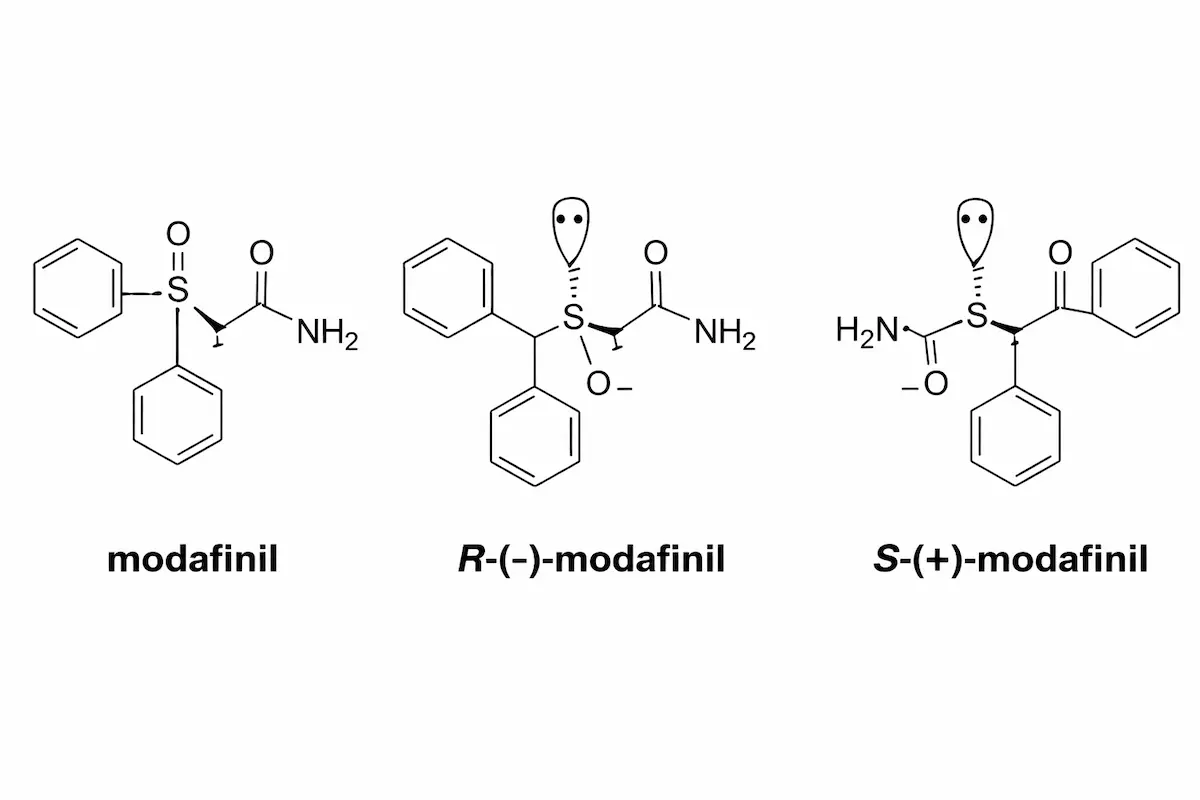
Armodafinil consists exclusively of the R-enantiomer (which is why it is called an “enantiomerically pure” compound) — the core of the modafinil vs armodafinil difference. This is the fundamental chemical difference between modafinil and armodafinil.
Pharmacokinetic properties
When it comes to judging in practice which drug wins and reflecting on whether modafinil or armodafinil would suit you better, we turn to the science:
[ 15 ] and is eliminated about three times faster than the R-form [ 16 ].[ 14 ].
Armodafinil contains only the R-enantiomer; studies recorded higher concentrations 6–14 hours after administration compared with modafinil 200 mg [ 17 ]:
“Compared with modafinil 200 mg, armodafinil 200 mg demonstrated… higher concentrations 6–14 hours after dosing, and also improved wakefulness and maintained attention for a longer period…”
Higher later concentrations of armodafinil may matter for the duration of wakefulness, but they do not allow predicting the effect or tolerability in any given person in advance. Do not choose a prescription drug for night shifts or work without consulting a doctor.
Bottom line: Armodafinil has a longer concentration profile, but that does not automatically make it preferable for every patient.
Doses of modafinil and armodafinil are determined by the approved indication, the prescribing information and the doctor. Comparing doses in milligrams does not mean the drugs are directly interchangeable.
The following standard regimens appear in prescribing information for specific indications; they are not a guide for self-administration:
The drugs are usually taken in the morning or according to a shift-work schedule. The source notes that higher doses did not show convincing additional benefit for some indications [ 18 ]; changing the dose without a doctor is unsafe.
If you are reviewing the range, compare modafinil forms and dosages in the modafinil catalog, but choose a prescription drug only after consulting a specialist.
Information about armodafinil forms is available if you are looking for a place to buy armodafinil, see the armodafinil catalog. Before you buy armodafinil, confirm the required dose with your doctor. A longer effect is not a reason to take the drug without medical indications.
Bottom line: Doses from prescribing information relate to specific indications; do not use this comparison to substitute or increase a dose on your own.
The safety of modafinil and armodafinil — a central part of any modafinil vs armodafinil review — is assessed by prescribing information, contraindications and individual factors. Clinical studies describe similar profiles of adverse reactions, but neither drug is safe for everyone [ 19 ]:
“…modafinil and armodafinil were effective and well tolerated in pediatric patients [<18 years] with narcolepsy over a long clinical follow-up period (up to 10 years). Concomitant use of other psychopharmacological agents did not produce any significant side effects… Use significantly improved the patients’ ability to stay awake and did not exacerbate existing psychiatric disorders.”
Studies reported headache, nausea, diarrhea and dizziness; the frequency and severity of reactions varied between studies [ 20 ]:
“Reported side effects were mild to moderate in severity. The most common side effects with armodafinil or modafinil were headache (29% and 2%, respectively), diarrhea (12% and 5%), nausea (10% and 2%) and dizziness (10% and 5%).”
Tolerability is individual. Before prescribing, a doctor assesses diseases, psychiatric history, blood pressure, pregnancy and the full list of medications [ 21 ]:
[ 22 ].[ 23, 24 ]. Always read the prescribing information for all concomitant medications.Discuss chronic conditions, pregnancy, plans for pregnancy and all medications you take with your doctor before starting, stopping or switching a prescription drug.
Bottom line: Both drugs require assessment of interactions and contraindications; a “mild” side-effect profile does not remove the need for medical supervision.
For anyone comparing where to buy modafinil and where to buy armodafinil, price depends on country, brand, dosage, insurance coverage and the date of the check. The Drugs.com figures below refer to the cited source and are not a current price list [ 25, 26 ]:
Before you buy armodafinil or modafinil, check availability, registration and dispensing conditions with a legal supplier. Do not rely only on advertising promises or price.
When comparing generics and original brands, consider not only cost but also the legality of dispensing, manufacturer information and the doctor’s prescription.
Prices in online stores and on the market change. The reference point cited in the source [ 27 ] does not confirm the quality, authenticity or medical suitability of any particular product.
Bottom line: Cost should not be the criterion for choosing on your own: first make sure the drug is actually prescribed for you and suitable.
There is no single winner in the armodafinil vs modafinil comparison. Both drugs have prescription indications, and the differences in composition and pharmacokinetics do not allow choosing therapy based on an article or reviews.
A practical comparison usually comes down to the duration of the concentration profile and individual tolerability, which a doctor assesses:
Do not run your own “trial” course and do not use the drugs for productivity outside approved indications. If a doctor has prescribed therapy and helped you decide whether to take modafinil or armodafinil, ask about the goal of treatment, expected effect, interactions, and the signs that mean you should stop and seek help.
Bottom line: Modafinil and armodafinil are compared on medical data, but the final choice and regimen must be clinical, not marketing-driven.

In short: modafinil and armodafinil differ in composition — modafinil contains R- and S-enantiomers, while armodafinil contains only the R-enantiomer. According to pharmacokinetic studies, armodafinil may have higher later plasma concentrations. This does not mean it will suit everyone better; the decision depends on the indication and the doctor’s prescription.
It is not reliable to call 150 mg of armodafinil “stronger” than 200 mg of modafinil for every person; modafinil or armodafinil is chosen according to the indication. Studies and prescribing information use specific doses for specific indications, and the drugs should not be recalculated or substituted for one another on your own. Whether you buy modafinil or armodafinil, do not recalculate doses yourself.
The onset of action depends on the drug, food intake and individual metabolism; so modafinil vs armodafinil is a question of regimen, not “speed”. Prescribing information and studies describe a possible delay in onset with food but give no universal time for every person. The time of administration is determined by a doctor to reduce the risk of insomnia.
There is a risk of dependence and abuse, although it may be lower than with some traditional stimulants; both modafinil and armodafinil are prescription drugs. They are controlled substances; do not change the frequency of dosing or use “5/2” schedules without a prescription and medical supervision.
The legal dispensing and delivery conditions for prescription drugs depend on the country, the prescription and the supplier; the question of where to buy modafinil is resolved only within the law. The same applies when you buy modafinil generics: registration and prescription requirements come first. Before purchasing, check the legal requirements, product registration and whether a prescription is needed. Catalog information does not replace medical advice.
Legality depends on your country: in the US both drugs are controlled prescription medicines, while rules for online orders differ elsewhere. Before you buy armodafinil online, check the local registration status and dispensing requirements, and remember that a prescription is the legal basis for use in most jurisdictions.
Generics are usually much cheaper than the original brands: the price difference can reach 50–90%. If you decide to buy modafinil as a generic, make sure the manufacturer is licensed and the product passed bioequivalence testing; price should never be the only selection criterion for a prescription drug.
Summary: comparing whether modafinil or armodafinil is more effective only makes sense in the context of a specific diagnosis and a doctor’s prescription. Both drugs are prescription-only; the choice is made by a specialist.

Author
Volodymyr — biohacking and pharmacology specialist
Author of medical reviews at modafinil.com.ua. Specializes in the pharmacology of wakefulness-promoting agents and the safe use of prescription drugs. Materials are based on FDA, PubMed and clinical research data and do not replace medical advice.
